Role-specific email evidence

Fit verification controls to the revenue decision

Founders, SDR leaders, RevOps teams, and outbound agencies use the same technical signals differently. Each workflow needs its own evidence threshold, review owner, suppression rules, and measurement plan.

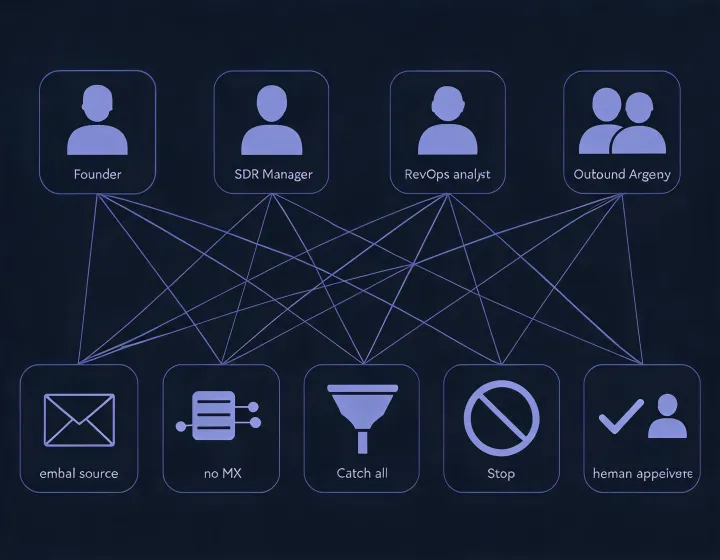
Revenue roles connected to email verification controls

Four operating contexts

SDR teams

Require a source-bearing record before a candidate enters a sequence. Syntax and domain checks remove obvious errors, while catch-all, role-account, or inconclusive mailbox states trigger review. Managers still govern relevance, volume, suppression, SPF, DKIM, DMARC, and hard-bounce monitoring.

Revenue operations

Store discovery and verification as separate fields with distinct source and checked time. Define waterfall provider order, retries, rate limits, overwrite rules, deduplication, CRM export, correction, and deletion. Conflicting providers should remain visible rather than silently collapsed.

Founders

Start with a narrow ICP and a small labeled sample inside the existing agent. Count accepted records, uncertain matches, reviewer time, provider calls, observed hard bounces, and relevant replies. A larger database is not automatically a better fit for a precise segment.

Outbound agencies

Separate each client’s ICP, credentials, suppression list, evidence threshold, exports, and retention policy. Record authorization, applicable regional rules, approved channel, and review ownership. A shared agent workflow must not become a shared client-data pool.
Choose the operating model by its trade-offs

DecisionOption AOption BWhat to verify
Data sourcingSingle source simplifies governance and deletion but may leave more unknown records.Waterfall enrichment may improve candidate coverage but adds cost, conflicts, retries, and more subprocessors.Provenance per field, provider order, refresh behavior, and deletion propagation.
Action controlHuman review adds operator time but protects targeting, suppression, and sender reputation.Automatic sending reduces touch time but magnifies errors and regional-policy risk.Approval roles, audit history, volume limits, opt-out, and emergency stop.
Quality objectiveDatabase scale broadens search options but says little about current role fit.Deliverability-focused filtering narrows candidates but cannot guarantee inbox placement.Labeled match rate, list age, hard-bounce outcomes, authentication, and segment relevance.
Execution pathAgent-native tasks reduce tool switching and seat overhead.A dedicated SaaS interface may expose deeper admin, reporting, and permission controls.Runtime support, auditability, total operating cost, and control coverage.

These are evaluation dimensions, not Findymail performance claims. Record the runtime, provider configuration, sample definition, and test date before comparing outcomes.

Run one role-specific verification task

Copy the installer and begin with an authorized labeled sample that includes valid, invalid, catch-all, and unknown states.

npx -y @okki-global/okki-go-taroball